
Understanding Anti-Material Rifles and CheyTac’s Role in Modern Warfare
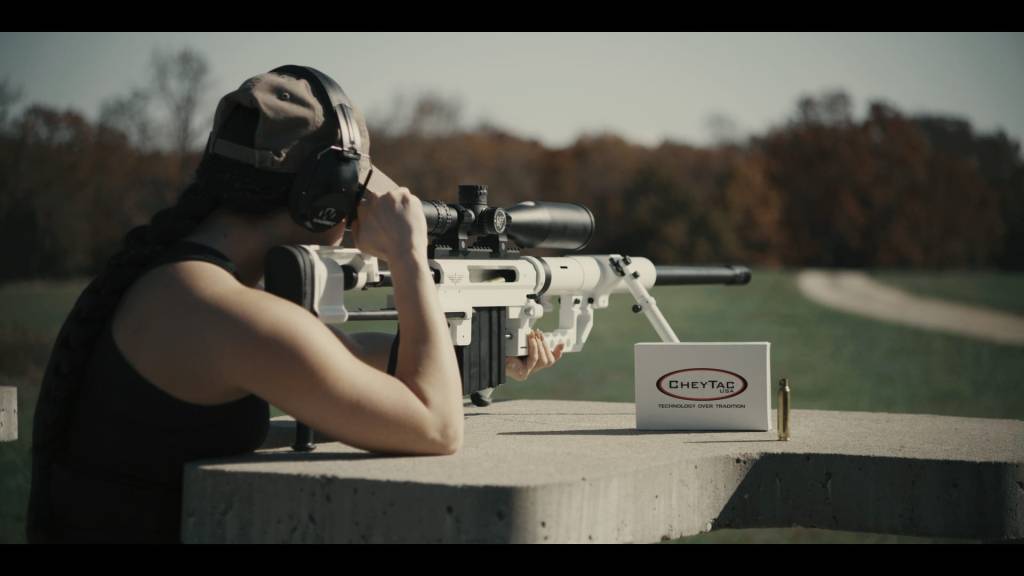
The term “anti-materiel rifle” is often used as shorthand for any rifle that is big, powerful, and capable of damaging both people and vehicles at long range. While directionally true, in military terms, anti-materiel rifles are defined less by size and more by the types of targets they’re capable of engaging.
Their role is to damage or disable equipment from a distance. That may mean a vehicle, a radar installation, a communications node, or some other piece of mission-critical hardware, but the basic idea is the same: these rifles are built with hard targets in mind, not just personnel.
Ammunition is a major part of that picture. An anti-materiel cartridge is not defined by size alone any more than the rifle itself is. The real question is whether the round can inflict enough damage at standoff range to render the target unusable.
The .50 BMG Benchmark
For most of the modern era, the .50 BMG has been the cartridge most closely associated with the anti-materiel role in the West. Originally developed by John Browning in the early 1920s for the M2 machine gun, the cartridge later became closely associated with anti-materiel and long-range precision rifles through platforms such as the Barrett M82 and its military successor, the M107.
Despite its age, the .50 BMG remains the standard for extreme long-range and anti-materiel cartridges. It carries a very heavy projectile at a high velocity for extreme distances. With the right powder load, it can engage vehicles, parked aircraft, and other hard targets at ranges well over 2000 meters.
At the same time, the .50 BMG was never designed specifically as a modern extreme-precision rifle cartridge. As long-range requirements have become more specialized, some of the round’s tradeoffs have become harder to ignore.
To withstand the cartridge’s power, .50 BMG platforms are large, heavy, and demanding to carry for long periods. The substantial recoil increases the rate of operator exhaustion, and the ammunition is bulky enough to limit what a team can realistically carry.
More importantly, the cartridge’s ballistic efficiency at extended ranges is beginning to lag behind that of modern designs. It’s good enough for a destructive effect on area targets, but less ideal when the mission demands a smaller rifle that delivers better precision on a variety of targets.
Bridging The Gap With CheyTac
By the early 2000s, military snipers had two primary options for extended-range work. The much lighter .338 Lapua Magnum offered excellent precision with manageable recoil, but its kinetic energy delivery was drastically lower beyond 1,500 meters. The .50 BMG could destroy anything it hit, but had all of the drawbacks we’ve already listed.
A new cartridge was needed to bridge the gap between the precision of the .338 and the destructive force of the .50 BMG. CheyTac began development of a cartridge that could out-range and out-hit the former while delivering substantially less recoil than the latter.
The result was the .408 CheyTac, developed by Dr. John D. Taylor and machinist William O. Wordman using a modified .505 Gibbs case (a historic British big-game cartridge) reworked to handle modern pressures and optimized for use at extreme ranges. These modifications made the cartridge purpose-built for both anti-personnel and anti-materiel roles.
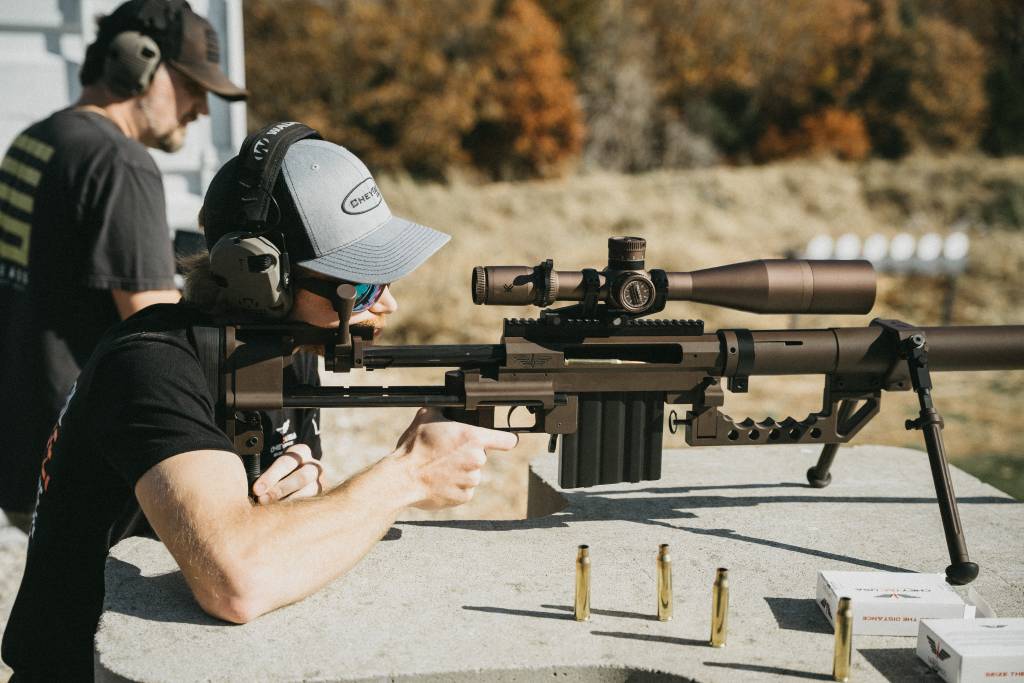
.408’s Anti-Materiel Properties
What makes the .408 CheyTac effective as an anti-materiel cartridge is its energy retention at standoff ranges while maintaining sub-MOA performance. The rifle provides the accuracy, stability, and range needed to place a shot at distance, but the actual hard-target effect comes from the projectile and what it is built to do on impact.
The standard .408 CheyTac load uses a 419-grain bullet using a copper-nickel alloy, rather than relying on a more conventional projectile structure. That gives the round the strength to withstand impacts from hard surfaces that would deform or disrupt more ordinary projectiles.
The ability to maintain structural integrity under extreme forces is integral to the performance of an anti-materiel round. A projectile still has to maintain its shape, remain stable in flight, and arrive with sufficient integrity to produce a useful effect against steel, concrete, mechanical components, or other resistant targets.
How CheyTac Platforms Fit Into The Picture
A powerful cartridge is great, but it only works as well as the rifle that fires it. The platform has to deliver that round with the kind of consistency that makes extreme-range engagements a viable field tactic.
That’s the job for rifles like the M200 Intervention® and M300 Praetorian, both of which were designed from the start to fit their cartridges for optimal delivery. The result is a more integrated system built to balance kinetics with ultra long-range precision.
The M200 was developed as a modernized alternative to the .50 BMG models, giving shooters a rifle that could still deliver serious anti-materiel capability while maintaining greater precision at range and less punishing logistics and operations. The platform was intended to function as part of a larger system that includes the .408 cartridge, modular optics, and ergonomics.
The integrated bipod system is a good example of how the M200 simplifies things in the field. Instead of mounting beneath the barrel in a conventional setup, it clamps around the barrel, keeping the pivot point aligned with the bore.
That means the shooter doesn’t have to adjust or compensate for uneven ground, as the rifle stays centered regardless of the surface it’s sitting on. Rather than asking the operator to assemble the best possible setup from separate components, the M200 builds it all in a single system that reduces the number of decisions and adjustments between the shooter and the shot, which at anti-materiel distances is exactly where mistakes tend to happen.
Anti-Materiel In Practice
All of these capabilities are aimed at enabling a small team to disable valuable enemy equipment from a distance sufficient that heavier assets or close-range assaults are not required. Modern battlefield technology has increased the effectiveness of asymmetric warfare, making these heavier assets more vulnerable, so a small team of specialist infantry equipped for anti-materiel missions can strategically punch far above their weight class.
A potential target for these teams could be a communications relay or radar component supporting enemy movement across a sector. An airstrike or cruise missile could remove it, but an uncontested airspace is not guaranteed. A team infiltrating with an anti-materiel rifle could disable vulnerable components and disrupt that capability from a safe distance before quietly exfiltrating.
To provide a real-world mission scenario, anti-materiel rifles have also seen significant use in Iraq and Syria as counter-VBIED (vehicle-borne improvised explosive devices) weapons. Standard rifle calibers can’t reliably stop an up-armored VBIED at a safe distance, but an anti-materiel round can penetrate the vehicle’s improvised armor or disable its engine before it reaches its target.
That’s where CheyTac fits into the story. The company did not invent the anti-materiel role, but it did build a more specialized system for it, designed to deliver the same kind of hard-target utility with greater precision and longer range. If you’re interested in learning more about the anti-materiel capabilities provided by CheyTac’s line of precision weaponry, follow us here!
FAQ’s
An anti-materiel rifle is built to engage equipment rather than personnel alone. That means the system must be capable of placing a projectile on hard targets like vehicles, radar components, communications gear, or other mission-critical equipment at standoff distance with enough retained force to damage or disable them.
No. Size matters, but it is not the whole story. Anti-materiel capability depends on the way the rifle, cartridge, and projectile work together to deliver accurate hard-target effect at long range. A larger round may carry impressive energy, but that does not automatically make it more effective against equipment if the system lacks precision, stability, or the right projectile construction.
CheyTac approached the category as a complete system rather than just a large-caliber rifle. Its .408 and .375 cartridges, along with platforms like the M200 Intervention, were designed to combine long-range precision, retained energy, and hard-target utility in a more specialized package than older .50 BMG-based systems.
In military usage, materiel refers specifically to military equipment, vehicles, weapons, and supplies. Material usually refers to physical substances like steel, wood, or fabric. So anti-materiel is the correct term because the category is concerned with disabling equipment and infrastructure, not attacking raw substances in the abstract.
