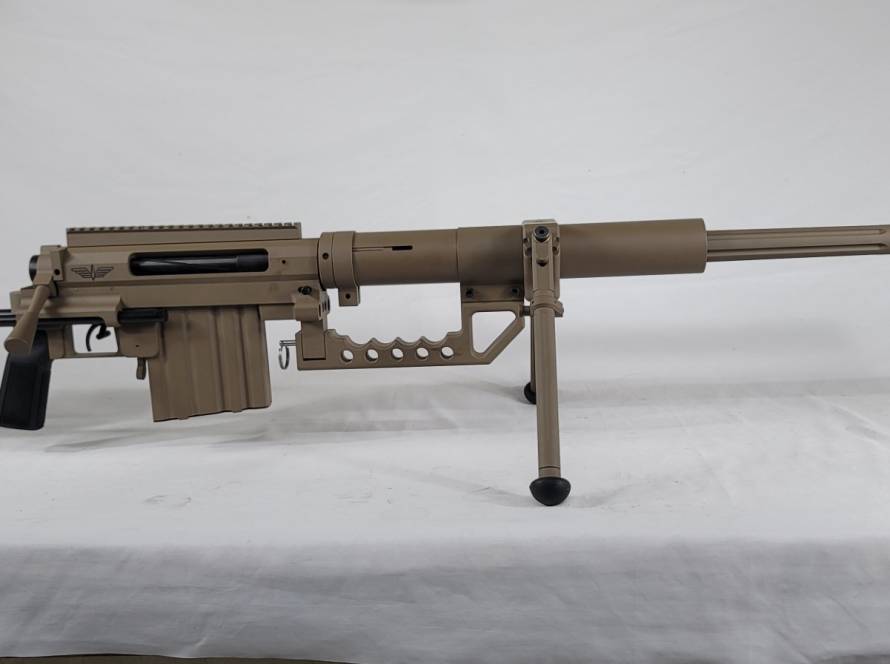
We have already written about the extensive history of the groundbreaking .408 CheyTac round, but the story doesn’t end there. Extreme long-range shooting is built on innovation, and the CheyTac team has never been content to rest on its laurels. While the .408 round was still making headlines, our ballistics experts were already hard at work on a lighter, more efficient successor: the .375 CheyTac.
What started it all: CheyTac Associates
When it comes to extreme long-range precision, few cartridges have made the splash that the .408 CheyTac made in the early 2000’s. Designed by Dr. John Taylor and machinist William O. Wordman of Tactical High Energy Impact Solutions (THEIS), the .408 Cheytac was designed from the ground up as a 2000-meter cartridge aimed directly at military applications.
The original design intent for the cartridge was to fill a noticeable ballistic gap between .338 Lapua Magnum and .50 BMG. What it achieved, however, was far more than anticipated. Beginning with a modified .505 Gibbs case with a strengthened web to handle modern chamber pressures, the patented Balanced Flight projectile was designed by Warren Jenson of Lost River Ballistic Technologies (LRBT) using cutting-edge computer software called PRODAS.
Dean Michaelis of Sniping Operations Executive (SOE) was asked to prove and analyze the .408 Cheytac’s real-world ballistic capabilities. Partnered with Dave Durham, Warren Jenson’s right-hand man at LRBT, Michaelis performed a meticulous analysis that yielded results that were nothing short of phenomenal.
These gentlemen and their respective companies banded together, and CheyTac Associates was born. The success of the .408 CheyTac cartridge, the M200 Intervention® Sniper Rifle System, and the CheyTac Advanced Ballistic Calculator (ABC) placed CheyTac Associates at the forefront of innovation for extreme long-range precision weapon systems.
Enter the .375 CheyTac
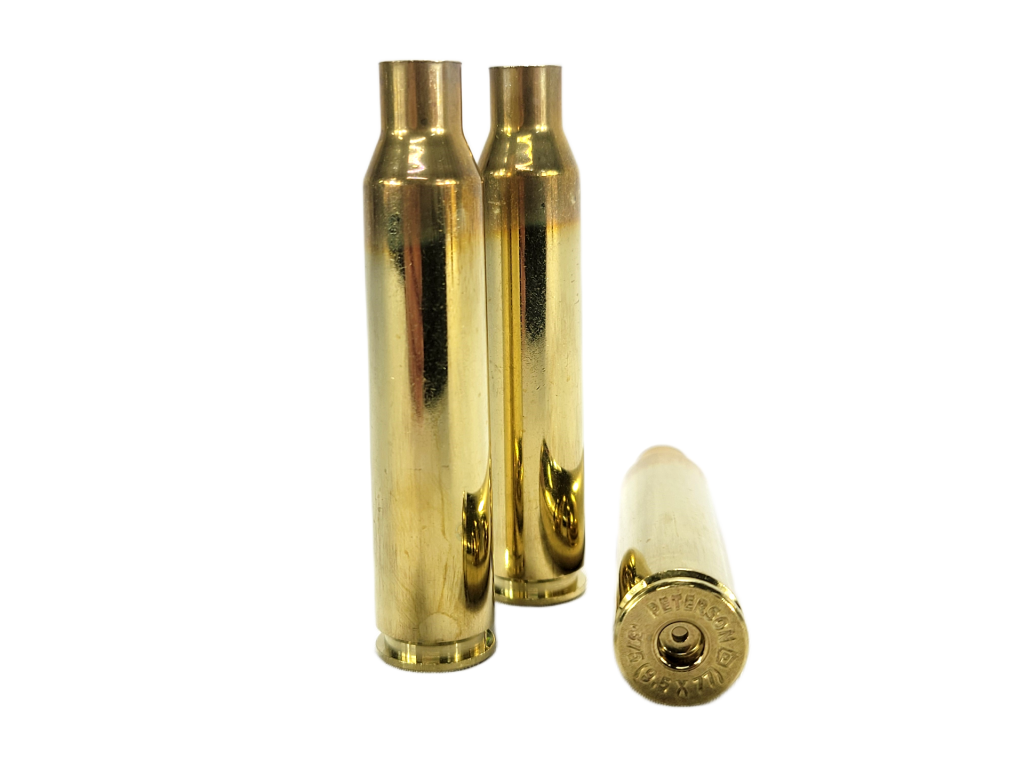
In 2006, Warren Jenson was asked to design a .375 caliber projectile by CheyTac’s barrel manufacturer, Barney Lawton of Lawton Machine, for a wildcat cartridge utilizing a necked-down .408 case. Lawton, in addition to making barrels and building rifles, was also an avid long-distance shooter and benchrest competitor.
Jenson obliged, and an all-new 350-grain .375-caliber balanced-flight projectile was designed using PRODAS software. Curious about the new projectile, Dean Michaelis and Dave Durham acquired loading dies and test barrels from Lawton and began to experiment with what was tentatively named the .375-.408. During their first test, they calculated the elevation adjustment by hand and dialed the optic for a 1580-yard target.
The impact confirmed a trajectory that was flatter than the .408, with an elevation difference of 10 minutes of angle (MOA), or 2.9 MILS at 1580 yards. Further development and testing proved that the .375 variant would follow in the footsteps of the .408 and be a game-changer in ELR shooting, drawing a new line in the sand for long-range ballistic capability.
Formally introduced in 2009, the .375 CheyTac shook the foundations of the ELR community, and its effects can still be seen today. It has inspired the development and innovation of new projectiles by manufacturers across the firearms industry, as well as a host of other .375-caliber wildcat cartridges. Sierra Bullets, in collaboration with CheyTac Associates, released their 350-grain MatchKing in 2012. Today, nearly every major long-range bullet manufacturer offers a .375 caliber projectile.
What makes the .375 Cheytac special?
The relationship between .375 CheyTac and .408 CheyTac is not dissimilar to that of the 6.5 Creedmoor and .308 Winchester. They are both necked-down derivatives of their predecessors, using smaller-caliber, higher-BC bullets that deliver faster velocities, flatter trajectories, less wind drift, and extended effective ranges.
This makes them obvious choices for their respective classes of competition, in which they are frequently used. Energy within the desired ranges for tactical and hunting applications is where the lines will begin to blur, with personal preference and bullet diameter & grain weight becoming more important factors.
The 350-grain Balanced Flight projectile can be fired at muzzle velocities of 3,000 fps and above. At 2950 fps, with an average G1 BC of .98, it stays supersonic to 2500 yards before transitioning to subsonic flight, which it does with high stability due to its patented design. This smooth transition further extends the maximum effective range beyond that of conventional projectiles.
A large portion of competition rifles for ELR are chambered in .375 CheyTac, and it has won the King of 2-Mile at least 3 times. The 2021 KO2M winner, Lindsey Paul, remains the only competitor to have three consecutive impacts on the 2-mile target. Numerous long-distance records have been set and broken using a .375 CheyTac rifle.
The .375 CheyTac has not only remained relevant to the present with its 350-grain weight class of projectiles but has also seen an increase in popularity in the last several years due to the development of heavier 390-425-grain projectiles from the likes of Berger, Hornady, and Cutting Edge. The trend towards longer, heavy-for-caliber bullets and faster twist rates has sparked renewed interest from new shooters and seasoned ELR veterans alike.
As bullet technology advances and shooters continue to push farther than ever before, the .375 CheyTac remains central to the evolution of long-range precision. It is a cartridge born of expertise and refined through real-world success, and its influence will continue to shape the next generation of extreme-range performance. To get updates on our expanding line of precision armaments, follow us here!